
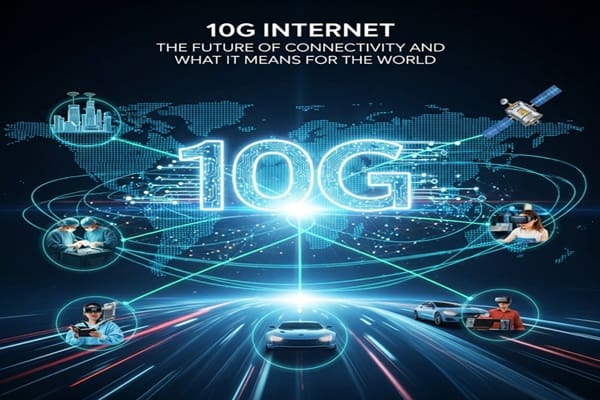
Imagine streaming an 8K movie, hosting a VR meeting, or playing an online game—all at once—without even a millisecond of lag. Sounds futuristic, right? Well, that future is already knocking on our doors with 10G Internet, the next giant leap in broadband technology.
Let’s take a closer look at what makes 10G such a game-changer, how it works, and why it’s not just about faster internet—it’s about transforming how the world connects, works, and lives.
What Exactly Is 10G Internet?
You’ve probably heard of 5G, the mobile network that powers faster phones. But 10G is something completely different.
While 5G focuses on wireless mobile devices, 10G Internet is about fixed broadband connections—the high-speed internet that powers homes, businesses, and smart cities. The “10G” stands for 10 gigabits per second (Gbps)—that’s 10,000 megabits per second (Mbps) of pure speed.
To put that in perspective, most home broadband users today enjoy around 100 to 200 Mbps. So yes, 10G is roughly 100 times faster than your typical connection today.
And it’s not just speed—it’s also about ultra-low latency (the time it takes data to travel from point A to B) and unbreakable reliability. With latency as low as 1 millisecond, 10G opens doors to technologies that simply can’t function on slower networks—like real-time VR, AI-powered automation, and remote surgery.
How 10G Internet Actually Works
Behind the scenes, 10G is built on a mix of advanced cable technology, fiber optics, and the DOCSIS 4.0 standard.
DOCSIS (Data Over Cable Service Interface Specification) might sound technical, but here’s the gist: it’s what allows your internet provider to deliver lightning-fast speeds over existing cable lines—without digging up streets to install new fiber.
Key Highlights of 10G Tech:
-
DOCSIS 4.0: Enables symmetrical upload and download speeds—something most connections can’t do today.
-
Hybrid Fiber-Coax Networks: Combine the best of fiber’s speed and cable’s accessibility.
-
Enhanced Reliability: Built-in redundancy and error correction ensure a rock-solid connection.
In simple terms, 10G is like giving your home internet a major turbo boost—without rebuilding the entire system from scratch.
How Fast Is 10G Internet, Really?
Let’s get real about speed.
| Connection Type | Typical Speed | Time to Download a 4K Movie |
|---|---|---|
| Standard Broadband | 100 Mbps | 6 minutes |
| Gigabit Internet | 1 Gbps | 40 seconds |
| 10G Internet | 10 Gbps | 4 seconds |
That’s right—your favorite two-hour 4K movie could be downloaded in less than 5 seconds.
But here’s where it gets even more exciting: 10G’s symmetrical speeds mean your uploads are just as fast as your downloads. So whether you’re a gamer, streamer, designer, or remote worker, you’ll experience an internet connection that finally keeps up with you.
Beyond Speed: What Makes 10G Truly Special
While speed grabs headlines, the real magic of 10G is in its low latency, scalability, and stability.
-
Ultra-Low Latency: Ideal for real-time applications like VR, AR, autonomous driving, and live gaming.
-
Scalability: Can easily support hundreds of connected devices in one household or office.
-
Stability: No more buffering, lag spikes, or dropped connections.
In short, 10G isn’t just “faster Wi-Fi.” It’s the foundation for the next digital revolution.
The Global Impact of 10G Internet
The arrival of 10G will affect far more than just streaming quality—it’s going to reshape entire industries.
1. Healthcare
Remote consultations and robotic surgeries will become more precise thanks to real-time data transmission. Imagine a surgeon operating across continents with zero delay.
2. Education
Virtual classrooms and immersive learning experiences will be accessible from anywhere, helping bridge the global education gap.
3. Transportation
Self-driving cars and smart traffic systems rely on fast, reliable networks. 10G will make connected cities a reality.
4. Business
From cloud computing to AI-driven analytics, companies can process massive data instantly, improving productivity and innovation.
5. Entertainment
Buffer-free streaming, interactive concerts, and ultra-immersive gaming will redefine how we experience digital entertainment.
This isn’t just about “faster Netflix”—it’s about transforming how society operates.
Real-World Applications Already Taking Shape
Even though full-scale deployment is still underway, 10G technology is already being tested across North America and Europe.
Some early examples include:
-
Smart Homes: Fully automated appliances, security systems, and climate control that respond instantly.
-
Telemedicine: Real-time diagnostics and video consultations.
-
Virtual Collaboration: 3D telepresence meetings where remote coworkers appear life-sized.
-
Smart Factories: Robots and AI-driven systems communicating in real time for maximum efficiency.
-
Next-Gen Gaming: Lag-free multiplayer worlds and ultra-immersive VR environments.
These pilot programs are just a glimpse of what 10G will bring as it rolls out globally.
10G vs 5G, 6G, and Beyond
The numbers can get confusing, so here’s the breakdown:
| Technology | Type | Speed | Focus |
|---|---|---|---|
| 5G | Mobile wireless | ~1 Gbps | Smartphones, IoT devices |
| 6G | In development | Up to 100 Gbps (theoretical) | AI-enhanced connectivity |
| 7G | Future concept | Unknown | Research phase |
| 10G | Fixed broadband | 10 Gbps | Homes, businesses, and institutions |
While 5G and 6G are all about mobility, 10G is about stability—a fiber-backed, always-on connection for homes, hospitals, schools, and enterprises.
Why 10G Is a Massive Upgrade Over Today’s Broadband
Here’s what sets 10G apart:
-
100x Faster Speeds than typical home internet.
-
Symmetrical Uploads and Downloads—perfect for creators and remote teams.
-
Stronger Security with end-to-end encryption.
-
Smarter Networks that adapt to demand using AI.
-
Scalable Infrastructure ready for future tech like metaverse platforms and smart cities.
These features make 10G the backbone of tomorrow’s connected world.
Security and Privacy in a 10G World
Of course, with great speed comes great responsibility.
10G networks will handle massive amounts of sensitive data—health records, financial transactions, and personal communications. To protect users, providers are incorporating:
-
End-to-end encryption to safeguard data.
-
AI-powered security systems to detect and neutralize threats in real time.
-
Regulatory compliance measures that uphold data privacy and consumer protection laws.
So while cyber risks remain, the 10G framework is being built with security baked in from the start.
Also Read : Who was Caveri Marley? Julian Marley’s Beloved Daughter
Challenges 10G Still Needs to Overcome
Despite its potential, rolling out 10G won’t be easy.
Here are a few hurdles to clear:
-
Infrastructure upgrades: Expanding fiber and updating cable networks takes time and investment.
-
Cost: Widespread adoption could be expensive initially.
-
Digital divide: Rural and developing regions may face slower deployment.
-
Technical expertise: A skilled workforce is essential for maintaining and securing new networks.
However, industry leaders like Comcast, Charter, and Liberty Global are already investing heavily in 10G infrastructure to make it accessible worldwide.
Countries Leading the 10G Revolution
The race to 10G is heating up globally.
-
United States: Comcast and Charter are spearheading trials and early rollouts.
-
South Korea & Japan: Leveraging dense cities to rapidly deploy 10G-ready networks.
-
Germany & the Netherlands: Integrating fiber infrastructure with next-gen DOCSIS technology.
-
China: Investing billions in ultra-high-speed internet as part of its digital economy strategy.
These nations understand that whoever leads in broadband innovation will lead in digital transformation.
The Environmental Side of 10G
High-speed doesn’t have to mean high waste. Many 10G projects are integrating green technology from the ground up—using recyclable materials, energy-efficient routers, and carbon-neutral data centers.
This push toward sustainability ensures that the digital revolution also supports a cleaner planet.
Economic Opportunities and Job Growth
Beyond faster browsing, 10G is an economic powerhouse.
Experts predict it will add trillions to the global economy by 2030, creating millions of jobs across industries like:
-
Cybersecurity
-
AI and data analytics
-
Telehealth
-
Smart manufacturing
-
Digital education
Think of it as the infrastructure that powers the next industrial revolution—only this time, it’s digital.
What the Future Looks Like with 10G Internet
In the next two decades, 10G will touch every part of our lives:
-
Smart Cities: Traffic, lighting, and energy grids all running seamlessly.
-
AI Homes: Appliances that anticipate your needs.
-
Global Learning: Students connecting to classrooms anywhere on Earth.
-
Decentralized Work: Businesses operating entirely in the cloud.
10G isn’t just about streaming faster—it’s about living smarter.
Final Thoughts: The Future Is 10G
At the end of the day, 10G Internet isn’t just a step up—it’s a total reinvention of what internet connectivity means. It promises speed, reliability, and limitless potential for innovation in every aspect of life.
Sure, there are challenges ahead. But as we move deeper into a digital-first world, 10G will be the invisible force powering our homes, our cities, and our future.
The future of the internet isn’t coming—it’s already here. And it’s called 10G.